


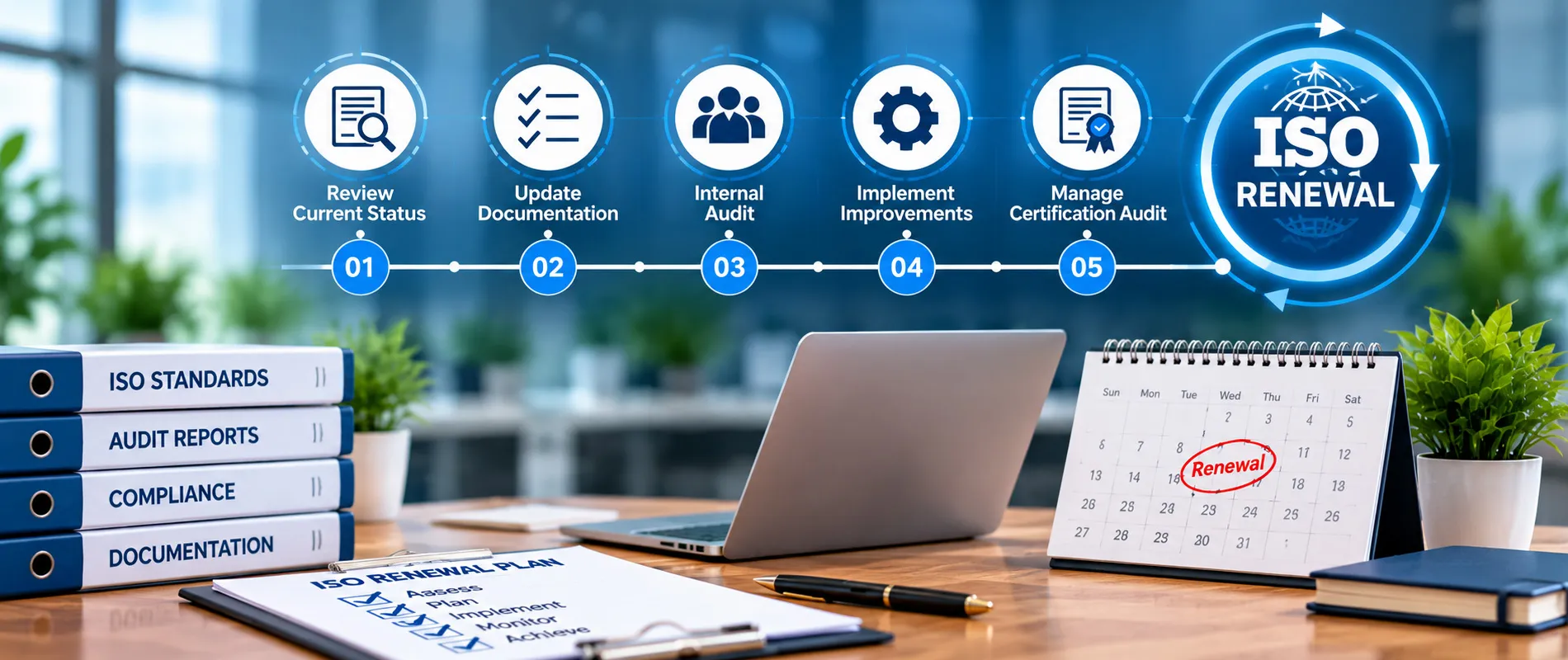
Preparing for ISO certification renewal should begin well before the existing certificate reaches its expiry date. Systematic ISO renewal planning schedule assists organizations to plan audits, management reviews, staff training, corrective measures, documentation changes and communication to the certification body. Premature planning will help avoid the last-minute stresses and allow teams sufficient time to recognize their limited areas and address them in the most appropriate manner. Iso compliance services in Saudi arabia are also utilized by businesses that require professional help with planning or gap assessment, internal audit, documentation or corrective actions. Clearly defined schedule helps manage the renewal process more easily and avoid missing essential responsibilities.
An effective renewal requires collaboration among the management and employees in the various departments. In place of renewal being a one-time audit event, businesses ought to break down preparation into feasible phases with definite timeframes and owners. The ISO renewal preparation timeline must take into account the date of certification expiry, the anticipated time of renewal audit, past audit results, internal audit needs, management review process and time to complete the corrective measures. By having a realistic plan, organizations will be able to keep their management system unchanged and will be able to better approach the renewal audit.
Understand the ISO Renewal Timeline
Check the Current Certification Expiry Date
The initial one is to verify the expiry date of the existing ISO certificate. It is this date, which should be worked back to, and milestones laid down in preparation. Previous audit schedules and certifications are also to be reviewed by businesses.
Identify the Expected Renewal Audit Period
Companies ought to discuss with their certification authority in advance the anticipated period of renewal audit. The approximate date assists teams to organize in-house audits, management reviews, employee-preparation and documentation actions.
Allow Enough Time for Corrective Actions
This should be prepared in time to deal with issues identified in internal reviews. Process changes, extra training, new documentation or new records may be needed as corrective measures, and as such they cannot afford to be left to the last weeks.
Start Renewal Planning Early
Set Key Preparation Milestones
A helpful timeline of ISO renewal preparation must also contain some distinct deadlines related to the reviews of the system, internal audit, management review, corrective actions, staff preparation, and last preparation check. It is easier to monitor the progress of the work broken into stages.
Assign Responsibilities to Internal Teams
The quality or compliance department should not be the only one when it comes to renewal. The department managers, process owners, HR teams, document controllers and senior management may all be required to have certain duties. The ownership should be clearly defined.
Establish Internal Deadlines
The certification audit date should be preceded by internal deadlines in general. This provides a buffer against unforeseen problems and allows employees ample time to accomplish pending tasks.
Review the Existing Management System
Assess Existing Processes and Controls.
The businesses are advised to check on whether the procedures that are written down are still adhered to. Consistency of records, objectives, risks, and monitoring activities, operational controls, and other related processes should be verified.
Review Changes Since the Previous Cycle
The management system can be influenced by changes on employees, facilities, suppliers, technology, products, services or processes of business. Organizations need to decide whether such changes need to be updated with procedures or controls.
Confirm Management System Consistency
The organization needs to ensure that activities that need to be performed are done and recorded accordingly. The problems that can be avoided during the renewal audit are inefficient procedures, lack of records or inconsistent implementing the procedures.
Schedule Internal Audit and Management Review
Plan Internal Audits Before Renewal
Internal audits need to be done in such a way that they are done early enough to detect areas of weaknesses and allow time to take corrective measures. The audit time is minimal because an audit is completed just prior to the certification audit.
Schedule Management Review Meetings
Management review enables the top management to review the results of the audit, objectives, risks, performance, resources, and opportunities of improvement. It also shows that the management is continuously engaged in the maintenance of the system.
Allow Time for Follow-Up
This schedule must have time to finish and confirm activities that are based on internal audit and management evaluations. It is not sufficient to identify a problem but businesses must ensure they can point out that measures have been undertaken appropriately.
Prepare Employees for Renewal
Refresh Employee Awareness
The workers are expected to be aware of the policies, goals, procedures and duties that are applicable in their position. Employees can be prepared through awareness sessions that will make them communicate effectively when responding to the questions posed to them by the auditors.
Provide Role-Specific Training
Depending on the duties of some of the employees, additional training might be required. The training may be oriented toward operational controls, documentation, risk management, emergency procedures, quality requirements or any other pertinent location.
Communicate Responsibilities
Departments ought to be aware of what they are to prepare ahead of the audit. Effective communication is useful in assuring that the records, documents, staff and evidence are readily accessible when needed.
Complete Corrective Actions Before Renewal
Prioritize Issues
All problems are not equally significant. The findings should be given priority based on the impact it has on compliance, operational performance, risk and effectiveness of a management system.
Assign Owners and Deadlines
Every corrective measure must have a person who will be in charge and a date of completion. An action tracker that is centralized can be used to measure progress by the management.
Verify Effectiveness
The root cause of the problem should be corrected and not the immediate problem fixed. Companies ought to ensure that the measure has been effective and that the problem will not recur.
Build the Final Renewal Readiness Schedule
Confirm Completed Activities
Prior to the audit, the management is supposed to ensure that internal audits, management reviews, training, corrective actions, updates in documentation and other scheduled activities are already done.
Conduct a Final Readiness Review
Any gaps can be created during a final review. The auditor should be required to visit teams that analyze the past results, records, procedures, objectives, and evidence.
Prepare Teams for Auditor Interaction
The employees must know their duties and the places of keeping the information which are relevant. They ought to tell the truth when asked a question and give relevant evidences where necessary.
Coordinate With the Certification Body
Confirm the Audit Schedule
The certification authority is to be contacted beforehand to establish dates and arrangements of the renewal audit. This is to make sure that important human and financial resources are on hand.
Clarify Audit Scope
Organizations ought to validate the scope of certification, sites, procedures and other relevant arrangements. The certification body needs to be informed about significant changes.
Coordinate Logistics
Practical arrangements and preparations before the audit should include business arrangements of meetings, access to facilities, records needed, availability of employees and other practical arrangements.
Use External Support When Needed
When Professional Support Can Help
External experts may help organizations in gap assessment, internal audit, review of documentation, staff awareness, guidance to take corrective actions and final preparation assessment.
Evaluate Support Providers
The businesses are advised to look into the relevant ISO experience, knowledge of the industry, practical approach and skills of the provider to collaborate with internal teams.
Maintain Internal Ownership
Internal capabilities should be complementary to external support and not substitutes. The management and employees have the responsibility of implementing, and maintaining the management system.
Maintain Compliance After Renewal
Address Findings Promptly
In case the findings are detected during the renewal audit, the organization should react within the stipulated timeframe as required by the certification body and present the necessary evidence.
Continue Monitoring Performance
Compliance is not terminated with renewal. Internal audits, management reviews, performance monitoring, risk assessment and constant improvement of businesses should be maintained.
Plan the Next Cycle
The renewal audit can be applied to learn lessons to enhance future planning. It may be more efficient to start the next cycle in time thus making the further certification activities more efficient.
Common Mistakes to Avoid
Businesses should avoid:
- Beginning to prepare a few weeks before certificate runs out.
- Delaying internal audits
- Assigning unclear responsibilities
- Remaining without corrective actions.
- Not updating the old documentation.
- Considering the renewal of ISO as a single audit.
- Failure to consider the awareness of the employees and management.
Practical ISO Renewal Preparation Timeline
|
Period |
Key Activities |
|
6–12 months before |
Review certificate, previous findings, scope, and renewal requirements |
|
3–6 months before |
Conduct internal audits, management review, system evaluation, and employee preparation |
|
1–3 months before |
Complete corrective actions, update documents, verify records, and conduct readiness checks |
|
Final weeks |
Confirm audit arrangements and prepare employees and evidence |
|
After renewal |
Address findings, monitor performance, and plan improvements |
Conclusion
A structured ISO renewal preparation timeline helps businesses organize certification activities without creating unnecessary last-minute pressure. Early start will enable organizations to examine their management system, carry out internal audit, engage employees, carry out management reviews as well as corrective action before renewal audit. There are also clear responsibilities and realistic deadlines that assist in effective collaboration of various departments.
The iso certification renewal is to be considered as part of the continuous desire to have an effective management system. Those businesses that maintain continuous monitoring procedures, overcome weaknesses, revise their performance, and upgrade their systems during the certification process are more equipped to undertake future renewal processes in a systematic and resolute way.